
Putignano, Italy
Ash Wednesday

Spoiler alert:
No saints are encountered here.
Well, that’s probably not true. Somewhere along the way, in the streets I walked, the churches I entered during these days, saints also walked, sat, ate, laughed and watched the parades.
But other than those anonymous holy ones, there won’t be any unexpected encounters with the canonized or the conflicted who had lessons to teach me here.
The unexpected, though, yes. Because every morning when you awake, that’s what’s in front of you: the unexpected.
Why me? we are tempted to cry when bad things happen to us or to those we love. Why us?
What you learn, though, after years of months, weeks and days living nothing but the unexpected is that the better question is really, why not me? Why not us? Why do I think I am that my life should be untouched?
Why not me?
Rember Naples? Sorrento? Where I saw the dogs? Puglia? Where I hit the dog?
Well, we’ve returned, tooling around Italy’s boot in the pre-collision Fiat, always a little nervous about parking, but generally in our element. My element.
I’d driven from Naples to Matera, and if you’ve never heard of Matera, go look it up. No wait – you can just stay here.
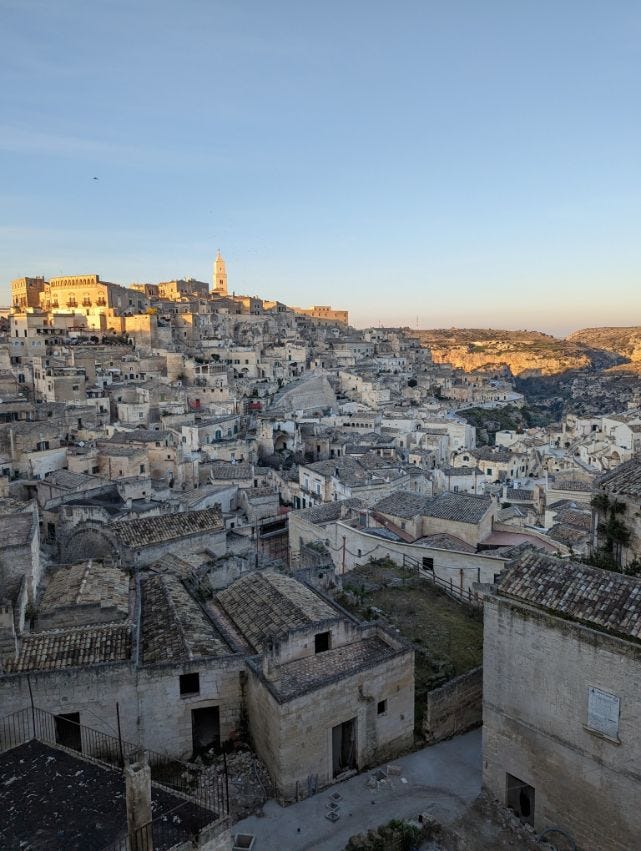
Ancient Matera is essentially caves dug out of hills, sassi they are called, and while now they are clean, picturesque and Instagram-worthy shops, apartments, restaurants hotels and even churches, this tourist-centric vibe is a recent development. For hundreds of years, little but misery and the deepest poverty dwelt in these caves.
Carlo Levi wrote about it in Christ Stopped in Eboli – he did not go there, but his sister, also a physician did, and this would have been in the 1920’s. What she described was hovel after hovel of misery, filth and malnutrition. It’s a little odd. You get a kick about staying in a “cave” AirBnB or hotel room, but what misery dug out that cave and made it its home? I guess it’s not as bad as partying it up on a plantation, which is the worst, but still there’s plenty of food for thought here
In 1952, the sassi inhabitants were evicted and sent to live in the apartments of the new town surrounding the hill. The site attracted filmmakers, notably Pier Paoli Pasolini, famed gay Marxist artist and filmmaker who decided to make a movie about Jesus. The part of him that was drawn by faith – sincerely, too – brought him to Matera where he filmed the raw, stark Gospel According to Saint Matthew.
Other movies followed, including, notably and more recently, Mel Gibson’s The Passion of the Christ and the opening scene of a Daniel Craig James Bond flick, No Time to Die.
Before those last two, though, in the 1980’s, the powers that were of Matera and the area had looked around and figured out that with some work, Matera could join Italy’s growing tourism business.
And so we have the shops and the hotels, electricity and water flow, and the hovels are a thing of the past. We walk around, climb up and down, peer into the caves, dine in them, sleep in comfort in them and try to imagine the old days. We can’t, of course. We can’t imagine what it would be like, so perhaps we give up trying and just settled into the charm.
I can’t though. Not really, not ever. But that isn’t just Matera, is it? If you’ve followed along, you know this. Even the structures and sites that were never even hovels, that were built with intentional magnificence, well, we know who built them don’t we?
Everything I see, it seems, presents itself to me with a cost. Labor, exploitation, the suffering inherent in creation, the pain and grief that birthed beauty, the defeat and humiliation that gave an emperor or a king or even some random Norman aristocrat the motivation to build monuments that I can study, cool stone towers that I can climb today.
I am never quite sure to what to do with that.
After Matera, it was Putignano, which I’m going to guess you’ve probably not heard of. I hadn’t heard of it either, not before I started researching where in the world I might go. I realized that I’d be in Italy right before Lent, which of course, is Carnevale time. Surely Venice isn’t the only Italian city with a celebration?
Indeed, it’s not. Somehow, Putignano’s celebration, with days of celebration and parades featuring fabulous, fantastical giant figures and floats, popped up, so of course, yes, I had to be there.
Especially since they say that Putignano’s Carnevale came first, even before Venice. They say.
Putignano is old, and therefore has an intricate, compact city center. I arrived in time for the Sunday parade, and there’s be another on Tuesday. In between there’d be displays of the floats, food, markets and music.
On parade days, about 2/3 of the adults were in some sort of question, and absolutely 100% of the kids. Besides Spiderman, most popular among boys was Harry Potter, and as predicted, judging from what I saw in Naples store windows, Wednesday Addams won among the girls.
It was intense and very, very Italian – that combination of the highest level of artistry (the floats, in this case) with abstruse storytelling, political digs, people walking in parades drinking beers and smoking, off-handedness and bottomless enthusiasm. Just good times, all around.


Oh, except for the three women who suddenly erupted into a physical fight very close to me, knocking me off the perch the short-even-in-Italy me had found on the base of a streetlamp. Two of the women were led away by authorities, and the first remained, upset, her face quite scratched up and the older man with her – I presume her father, occasionally erupting into impassioned emotive speech about what had just happened. So that was not a good time for them, but quite absorbing for the rest of us…


The theme that year was something about fairy tales, but in perusing the stories behind these floats, they seemed to be newly created “fairy tales” which, in turn, seemed to be mostly about communities finding freedom from oppression. And one about a boy and girl finding connection through unlimited gigabytes? I think? The one with the Phoenix was political – about women rising to power. I don’t quite understand the presence of King Charles, and other than Giorgia Meloni, I don’t know who the other women are, but I’m assuming one is the president of the EU…..
Each large, weird float was preceded by a group that was, I think, acting out, in an interpretive dance type fashion, the story of the float.
In addition, other groups were part of the parade (no live bands, though – Italian marching bands are my favorite, so that’s too bad) – I am not sure who they were or what their associations were, but they ranged from puzzling to entertaining. There were at least two hundred walking dressed as Alice in Wonderland characters. The music didn’t seem to have a relation to Alice, and the dancing was cheerful, but perfunctory, so that was weird.
I think what I enjoyed, after the artistry of the floats, was the just shear amateur-level fun that was being had. There was dancing, and there were moves, but the people doing them ranged from little children, to people pushing strollers, to young women who were very precise, to young men who were absolutely game for whatever was up and not embarrassed at all, even if they were having to wear glittery, light-up wings, to older women who still had their moves, to older men giving it their loopy, cheerful all.
And then, of course, silence fell, confetti drifted across relatively empty streets, and it was Ash Wednesday.
Keep reading with a 7-day free trial
Subscribe to The Saint Around the Corner to keep reading this post and get 7 days of free access to the full post archives.